
Commercial Snow Removal & Ice Management in Colorado Springs, CO
SIMA and ASCA accredited snow teams with Certified Snow Professionals on staff, 200+ pieces of dedicated snow equipment, and in-house liquid de-icer production, serving 300+ commercial properties across Colorado since 2011.
Parking lots, drive lanes, sidewalks, and entrances cleared to your service triggers for offices, retail centers, medical campuses, schools, industrial sites, and multi-family communities throughout Colorado Springs and El Paso County.
DCPS delivers commercial snow removal and ice management across Colorado Springs and El Paso County, covering parking lots, drive lanes, loading zones, sidewalks, and building entrances on a single contract. Snow crews work the I-25 and Powers corridors and the downtown, north, and east commercial submarkets, serving office parks, shopping centers, medical campuses, school and university facilities, industrial and warehouse sites, and multi-family communities.
Snow season in Colorado Springs is longer than most property budgets assume. Measurable snowfall arrives as early as October and continues into May, and the heaviest months are March and April rather than midwinter. Late-season storms bring wet, dense snow that loads sidewalks and refreezes overnight, which is why a season-long service agreement protects a property better than storm-by-storm calls to whoever answers the phone.
The snow and ice management program was built around low-tolerance sites where a single icy walkway becomes a claim, and it has been tested on five zero-tolerance hospital campuses under a five-year service relationship. Self-performing crews, company-owned equipment, and in-house de-icer production mean no subcontractor scramble when a storm arrives ahead of forecast.
Commercial Snow and Ice Services in Colorado Springs
Every Colorado Springs property gets a written scope before the season starts, covering which surfaces are cleared, at what accumulation trigger, and in what order. The services below are delivered under one contract by DCPS crews and DCPS equipment, so a single point of contact owns the whole property from the first flake to the final haul-off.
- Snow Plowing and Parking Lot Clearing:
Plowing and stacking for parking lots, drive lanes, loading docks, and fire lanes, sequenced so premium stalls and main access points open first.
- Ice Abatement and De-IcingLiquid anti-icing before the storm and granular de-icer after it, using brine produced in-house rather than whatever bulk product is available mid-season.
- Sidewalk and Entrance ClearingHand crews and walk-behind equipment for sidewalks, entries, stairs, and ADA ramps, the surfaces that carry the most liability under Colorado Springs city code.
- Snow Hauling and Stockpile Relocation
Loading and trucking snow off site when piles start consuming parking capacity, blocking sightlines, or draining across walkways as they melt.
- Pre-Season Planning and Site Mapping
Property walk, hazard identification, snow storage mapping, and service triggers agreed in writing before the first storm of the season. - Storm Monitoring and Photo Reporting
Forecast tracking ahead of each event, crew dispatch decisions, and time-stamped before and after photos filed for every service visit.
Get In Touch
Commercial Snow Plowing in Colorado Springs
Plowing a commercial lot is a sequencing problem before it is an equipment problem. A property with three entrances, a loading dock, and 400 stalls cannot be cleared in a single pass, so the order of operations decides whether tenants arrive to open access or to a lot that is still half blocked at 8am. DCPS agrees that order in writing with the property manager before the season starts, then runs it the same way on every event.
Premium parking, main entrances, fire lanes, and ADA stalls come first, because those areas generate both tenant complaints and liability exposure. Drive lanes open next to keep traffic circulating, then overflow and perimeter parking. Loading docks are timed around delivery windows rather than cleared last by default, which matters on industrial and grocery-anchored sites along the Powers corridor where a blocked dock stops the business.
Service triggers are set per property rather than across a portfolio. Medical campuses, senior living communities, and high-traffic retail centers typically run zero tolerance with crews dispatched as accumulation begins, while warehouse and industrial sites often sit comfortably at a two or three inch trigger. Each Colorado Springs property gets its own trigger written into the contract, along with what happens during multi-day events when snow keeps falling after the first push.
Parking Lot Snow Removal and Snow Storage in Colorado Springs
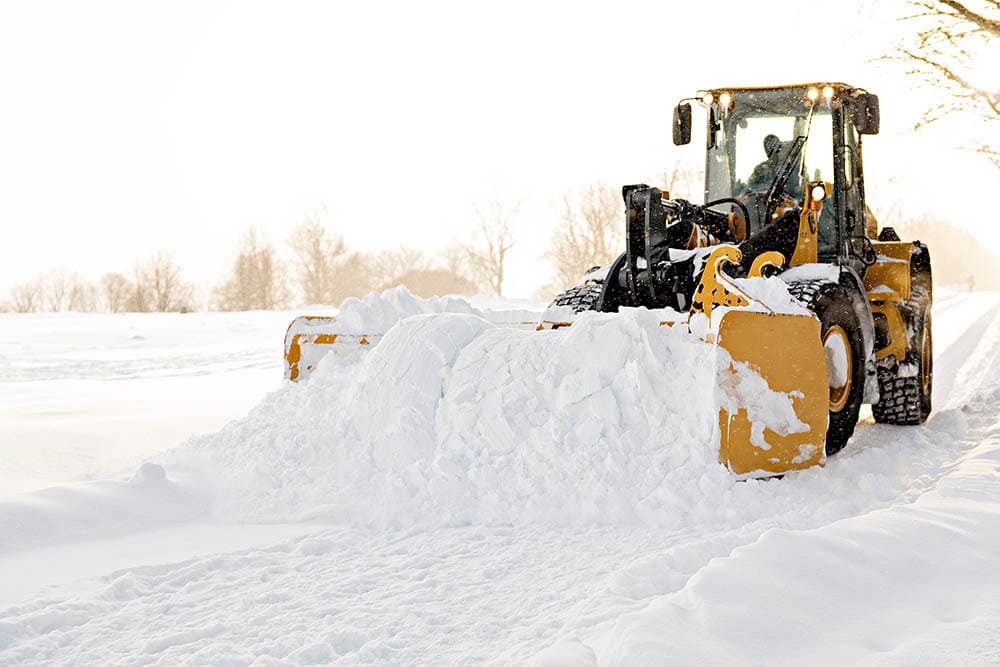
Colorado Springs averages 243 sunny days a year, and that sunshine works against a badly planned snow pile. Snow stacked uphill of a walkway melts across it through the afternoon and refreezes into sheet ice after dark, which quietly converts a cleared property back into a claim risk overnight. Storage locations are mapped during the pre-season property walk so meltwater drains toward inlets instead of pedestrian routes, sightlines at exits stay open, and piles never sit on landscape beds and irrigation heads that would need repair in spring.
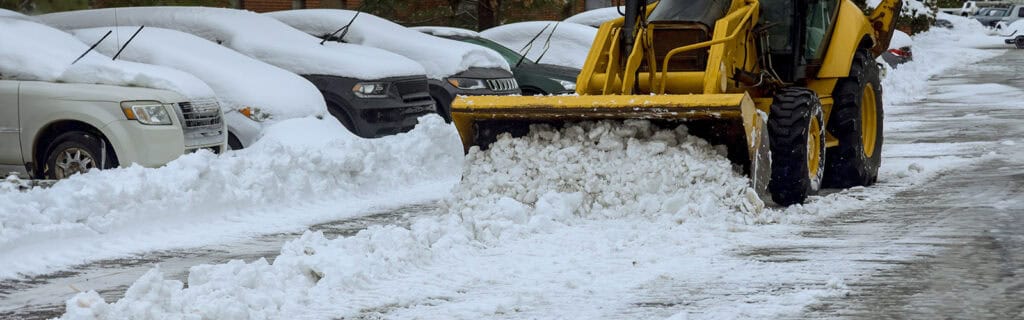
Stockpile placement also protects parking capacity. On tight retail and office sites, three or four storms of accumulated snow can consume a full row of stalls, so the plan identifies in advance which areas absorb snow and at what point piles get loaded out rather than pushed further. Equipment is matched to surface and site size, with more than 200 pieces of snow equipment including front-end loaders, skid steers, blowers, and plows, and sectional pushers used on open lot surfaces to leave a cleaner scrape and reduce the ice film that causes slips. Matching machine to surface protects the pavement itself, since aggressive blades on worn asphalt tear at seams and add asphalt and concrete repair to the spring budget.
Commercial Ice Abatement in Colorado Springs
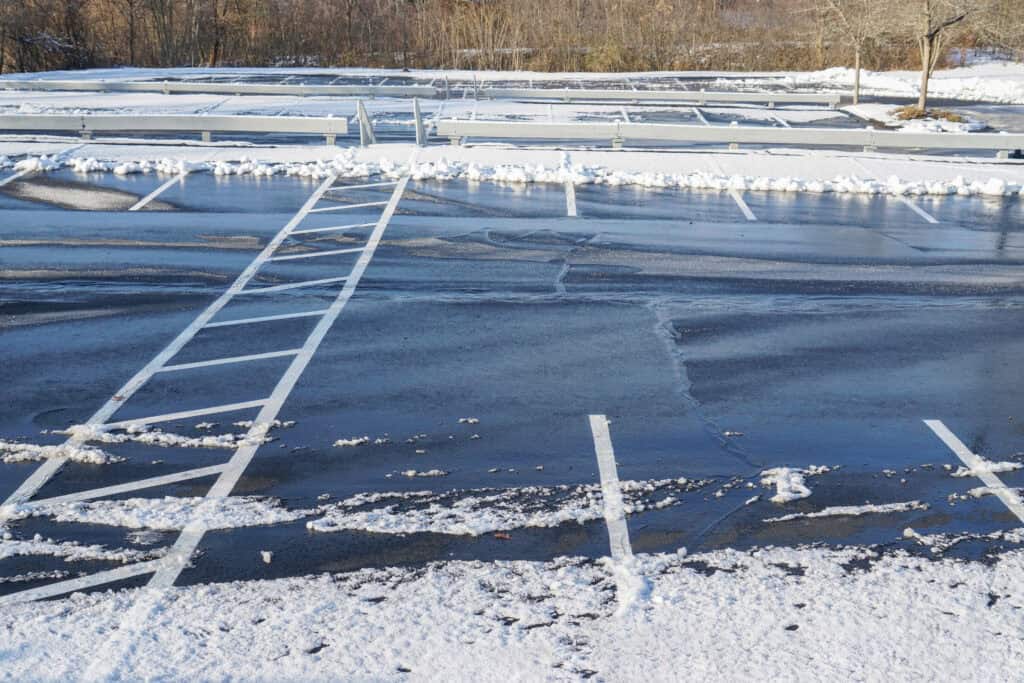
Ice, not snowfall, is what turns a Colorado Springs property into a claim. The city sits at 6,035 feet with 243 sunny days a year and average overnight lows near 18 degrees in December and January, which produces a daily freeze-thaw cycle for months at a time. Snow melts off south-facing pavement in the afternoon, that meltwater runs across walkways and drive lanes, and it refreezes into clear ice after dark. A lot that looked spotless at 2pm can be the most dangerous surface on the property by 6am.
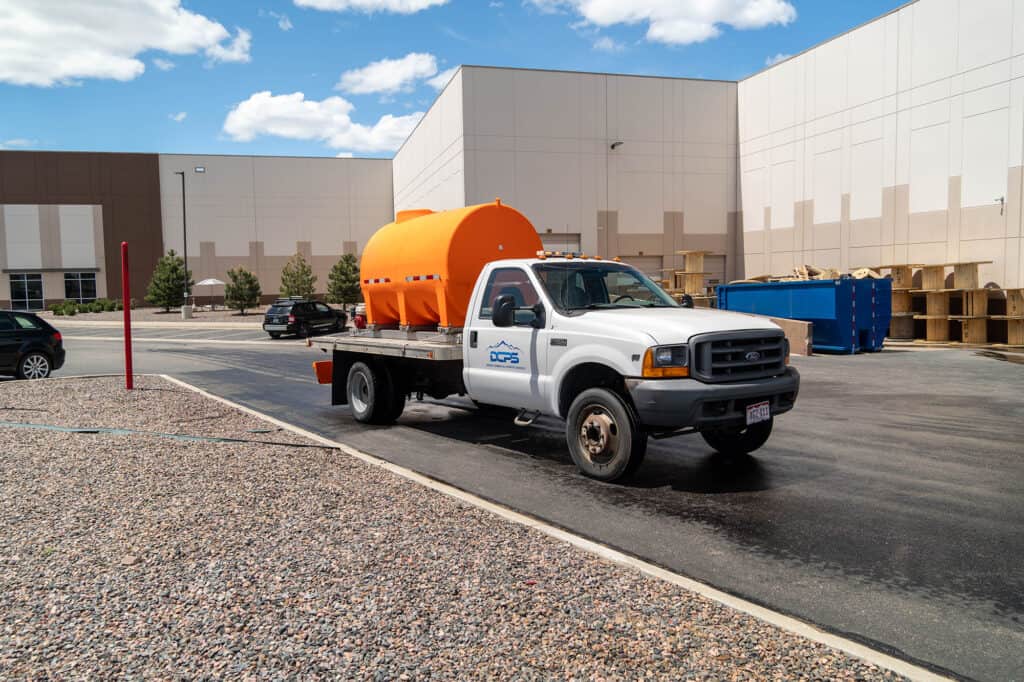
Treating that cycle takes timing more than volume. DCPS applies liquid anti-icing before a forecast event so snow and ice cannot bond to the pavement in the first place, then follows with granular product after the storm where refreeze risk is highest. A fleet of more than 35 full-size de-icer trucks means a portfolio of properties gets treated inside the same window rather than in sequence across two days, which is the practical difference between a pre-treatment program and a promise of one.
Every application is documented with temperature-stamped photos and the weather data behind the decision to treat. That record matters twice: it tells a property manager what was applied and when, and it becomes the evidence file if a slip and fall claim arrives six months later. Ice abatement and de-icing operations run on the same reporting standard across every property under contract.
De-Icing Products Matched to Colorado Springs Temperatures
Most de-icing failures are chemistry failures, not effort failures. Rock salt stops working reliably in the low twenties, and Colorado Springs sits below that for stretches of most winters, so a salt-only program leaves ice bonded to pavement exactly on the nights that matter. DCPS carries three product types and selects by pavement temperature and forecast rather than by whatever is in the yard.
- Liquid anti-icing brine: applied before the storm to stop snow and ice bonding to the surface, which cuts the amount of material and labour needed once the event begins. DCPS produces its own liquid de-icer in-house, so supply does not depend on regional shortages during a heavy season.
- Granular de-icer: a high-performance product used after clearing on the surfaces most likely to refreeze, including shaded walkways, north-facing entries, and drainage paths.
- Ice-melt: applied to lower the freezing point and break up ice that has already formed, targeting accumulation on stairs, ramps, and entries where clearing equipment cannot reach.
Product selection also protects the property underneath it. Over-application is the most common cause of concrete scaling on sidewalks and entry aprons, and the repair bill lands on the owner two or three seasons later rather than on the contractor who caused it. Calibrated dispensing keeps material on the surfaces that need it and off turf and landscape beds, where chloride runoff kills plantings and shows up as a spring replacement cost.
Sidewalk, Entrance, and ADA Access Clearing in Colorado Springs
Sidewalks carry the legal exposure. Colorado Springs city code places an affirmative duty on commercial property owners to clear the public sidewalk abutting their property, and failing to do it is treated as negligence in its own right rather than as a minor code issue. Parking lots get the attention and the budget, but the walkway between the lot and the front door is where the claims come from.
Clearing those surfaces properly takes different equipment and different people than the lot does.
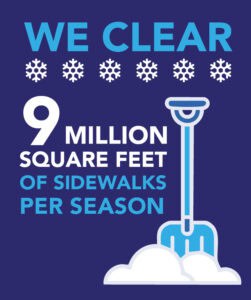
Plows cannot reach entries, stairs, ramps, or the pinch points between parked cars and building doors, so DCPS runs dedicated hand crews with walk-behind machines and purpose-built sidewalk equipment that dispenses de-icing material as it clears. Across all properties under contract, those crews clear roughly nine million square feet of sidewalk per season.
At that volume, the work stops being a bolt-on to the plowing route and becomes its own staffed operation with its own timing, which is the difference between sidewalks cleared alongside the lot and sidewalks cleared whenever a plow driver has a spare twenty minutes.
Priority Surfaces on Every Colorado Springs Property
Each property gets a written walkway scope during the pre-season assessment, mapping which pedestrian surfaces are cleared and in what order.
The surfaces that come first are the ones carrying the highest traffic and the highest liability.
- Building entrances and vestibules, including the tracked-in slush that refreezes at thresholds overnight
- ADA ramps, access aisles, and van-accessible stalls, where partial clearing still leaves a property non-compliant
- Public sidewalks abutting the property, the surfaces the city ordinance actually names
- Stairs, handrail approaches, and elevated walkways, which refreeze faster than ground-level pavement
- Transit stops, crosswalk landings, and paths between buildings on multi-building campuses into the same weather that everyone else drives through.
On healthcare campuses, senior living communities, and school sites, walkway clearing typically runs zero tolerance and starts before the lot does, because patients, residents, and students arrive on foot
Colorado Springs Snow Contracts Are Booked Before the First Storm
Equipment, crews, and route capacity for the season are committed in advance, and the properties that sign early get the earliest positions in the clearing sequence. Pre-season site assessments for Colorado Springs commercial properties are running now.
Snow Hauling and Stockpile Removal in Colorado Springs
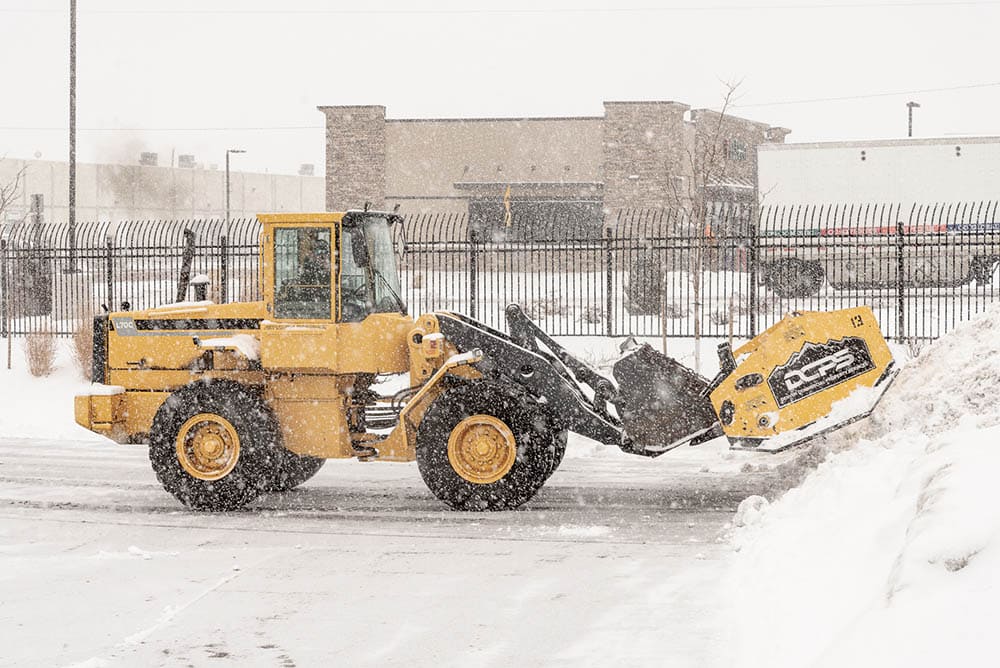
There is a point in every heavy season where pushing stops working. Piles reach the height a loader can stack, they start eating parking stalls the property is contractually obliged to provide, and the snow that was cleared in December is still sitting on the lot in March taking up space and melting across pavement every afternoon. At that point the snow has to leave the property rather than move around it.
Hauling is a loading and trucking operation rather than a plowing one, and DCPS self-performs it with company loaders and trucks. Crews load stockpiles, haul the volume to an approved disposal site, and complete the work outside business hours where the property requires uninterrupted access. Because the same company already holds the snow contract, hauling gets triggered from the site manager’s assessment rather than from a scramble to find a trucking subcontractor mid-season, when every hauler in the region is already committed.
When Colorado Springs Properties Need Snow Hauled Off Site
Hauling is not a default line item on every contract. It gets scoped when the property’s own constraints make on-site storage a liability rather than a convenience.
- Parking capacity falls below lease or code requirements because stockpiles have taken over stalls, which becomes a tenant issue and sometimes a compliance one
- Sightline obstruction at exits and intersections, where piles at driveway entrances block the view of oncoming traffic and pedestrians
- Meltwater draining across walkways, the refreeze problem that turns a cleared property into an ice hazard every evening
- Back-to-back storms with no melt window between them, common during the March and April peak when snow arrives faster than it can disappear
- Tight urban and infill sites with no landscape islands or perimeter areas to absorb accumulated snow
Removing accumulated snow also protects the pavement and grounds it was sitting on. Stockpiles concentrate chloride and grit in one place, and when they finally melt they leave behind killed turf, damaged irrigation heads, and a debris load across the lot. Properties on a year-round contract move straight from hauling into spring lot sweeping, so the sand and material left by the season is cleared before it clogs drains or gets tracked into buildings.
What Colorado Springs Snow Removal Law Requires From Commercial Properties
Colorado Springs City Code 3.4.202 makes snow and ice removal a legal duty rather than a maintenance preference. Commercial property owners must clear the sidewalks abutting or crossing their property by 5:00 p.m. on the next business day after snowfall ends, a tighter standard than the 24 hours given to residential property. The clock only starts once snowfall has actually stopped, which the code defines as a break in snowfall lasting more than four hours, so a storm that pauses and resumes has not ended for the purposes of the deadline.
The consequences sit well beyond a citation. The code states that the duty exists to protect public safety and that violating it constitutes negligence per se, an unlawful act carrying civil liability for any injury caused, civil liability for the city’s cost of removal, and exposure to criminal prosecution. In practical terms, negligence per se means an injured pedestrian does not have to prove the property owner was careless. The unshoveled sidewalk is itself the proof.
Business days exclude weekends and federal, state, and city holidays, which creates the exposure most property managers miss. A Friday evening storm gives a commercial property until 5:00 p.m. Monday under the ordinance, while the sidewalk stays in use all weekend and the liability for a fall on it does not pause. Properties on a service contract with defined triggers get cleared on the weather, not on the calendar.
How Often the Clock Starts: Colorado Springs Snowfall by Month
The deadline matters more often than the reputation of the city’s mild winters suggests, and it lands at a different time of year than most budgets assume. National Weather Service climate normals for 1991 to 2020 record 32.5 inches of average annual snowfall at Colorado Springs, spread across roughly two dozen days with measurable snow. March and April are the heaviest months, ahead of December and January.
NWS normals 1991–2020
month of the year
snowfall, October to May
for commercial sidewalks
Those late-season storms behave differently from midwinter snow. March and April systems arrive warmer and wetter, dropping dense snow that compacts fast under traffic and refreezes hard once temperatures drop after dark. It is also the period when seasonal contracts have often lapsed and property managers assume winter is finished, which is exactly when a slip and fall claim is least expected and least defensible.
Service agreements written for Colorado Springs run October through May for that reason, with pre-season planning and site mapping completed before the first event and documentation maintained through the last one.
Pre-Season Planning and Risk Management for Colorado Springs Properties
The work that decides how a property performs in a storm happens months before the storm. A crew arriving at an unfamiliar Colorado Springs site at 4am in a whiteout will find the fire hydrant, the drainage inlet, and the customer’s preferred snow storage area by hitting them with a loader. Planning is what prevents that, and it is also what produces the documentation trail that protects the owner if a claim is filed later.
Every Colorado Springs property under contract goes through the same pre-season process before the first event, and the output is a written site plan rather than a verbal understanding.

Property Evaluation and Hazard Mapping
A site walk documents everything a plow operator needs to avoid and everything a site manager needs to prioritise: hydrants, drainage inlets, curb stops, irrigation heads, low-clearance structures, and the pavement damage that already exists before the season starts. Peak foot and vehicle traffic areas get identified at the same time, because those surfaces determine where clearing begins.

Site Mapping and Snow Storage Plan
Each property receives a marked map showing clearing zones, priority sequence, and approved snow storage locations chosen so meltwater drains toward inlets instead of across walkways. On tight Colorado Springs retail and office sites, the plan also sets the threshold at which stockpiles get hauled off rather than pushed further into the lot.

Service Triggers Agreed in Writing
Accumulation triggers, response windows, and the specific surfaces covered are written into the contract before the season rather than negotiated during an event. Zero-tolerance properties get crews dispatched as accumulation begins; other sites run to an agreed depth. Multi-day storm protocol is defined at the same time, so nobody is deciding at 2am whether a second push is authorised.

Crew Briefing and Site Assignment
Crews are briefed on property access, gate codes, salt storage locations, plow routes, and site-specific restrictions before they are dispatched. Consistency of assignment matters as much as the briefing itself, because an operator who has run the same Colorado Springs property through several events works faster and damages less than one seeing it for the first time.

Pre and Post-Storm Assessments
Sites are assessed before each forecast event to confirm readiness and material placement, then again after clearing to identify refreeze points, missed surfaces, and hazards that developed during the storm. The post-storm pass is where late-forming ice at downspouts, roof drainage lines, and shaded entries gets caught before it causes an injury.

Quality Control Audits and Documentation
Quality control audits run during and after snow events, confirming hazards were addressed, stockpiles were placed correctly, and the agreed scope was actually delivered. Every visit is documented with time and temperature-stamped photos, and that record becomes the property’s evidence file if a slip and fall claim arrives months after the season ends.
Documentation is the part that separates a snow contract from a snow vendor. Under Colorado Springs City Code, an injured pedestrian claiming an uncleared sidewalk does not have to prove the owner was careless, so the owner’s defence rests on being able to show what was done and when. A dated photo record of every service visit is the difference between arguing a claim and settling it. Snow planning and risk management is included in every contract rather than sold as an upgrade.
One Contract, One Point of Contact, Every Surface on the Property
Parking lots, drive lanes, sidewalks, entrances, and haul-off handled by the same company, with one site manager accountable for the whole property from the first flake to the spring cleanup.
Why Colorado Springs Properties Choose DCPS for Snow and Ice
Most snow contractors in the Colorado Springs market are landscaping companies that plow in the off-season. The equipment, the certifications, and the crew structure reflect that. DCPS runs snow as a dedicated division with its own management team, its own fleet, and its own reporting standard, which is what low-tolerance properties require and what a seasonal side operation cannot provide.
Certified Snow and Ice Management
The management team has completed the Accredited Snow Contractors Association snow management program, and the division holds credentials that no competing Colorado Springs snow provider currently displays. Certification matters here for a practical reason rather than a decorative one: ASCA and SIMA standards define how service is documented, and documentation is what defends a property owner against a slip and fall claim.
- Snow & Ice Management Association (SIMA) certified
- Accredited Snow Contractors Association (ASCA) certified
- Certified Snow Professionals (CSP) on the management team




Self-Performed Scale, Not Subcontracted Capacity
When a storm hits the entire Front Range at once, every subcontractor in the region is committed to whoever called first. DCPS owns its snow equipment and employs its snow crews, so capacity on a Colorado Springs property does not depend on who is available that night.
snow equipment owned
snow pushers
de-icer trucks
each snow season
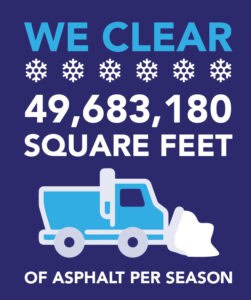
cleared per season
cleared per season
Featured clients









Snow and Ice Coverage Across Colorado Springs and El Paso County
DCPS snow crews cover commercial properties throughout Colorado Springs and the surrounding El Paso County markets, from the I-25 and Powers corridors to the north-side and downtown business districts. The same crews, equipment, and reporting standard extend to Monument, Fountain, Falcon, Peyton, Widefield, Security, Manitou Springs, and Woodland Park, with the Front Range coverage area continuing north through Castle Rock and Douglas County into the Denver metro.
Snow and ice management is one part of a year-round program for Colorado Springs properties. The same service area covers commercial roofing in Colorado Springs and full commercial property services across El Paso County, so a property under a snow contract has one point of contact for the surfaces cleared in winter and repaired in spring.
Colorado Springs Commercial Snow Removal FAQs
The questions Colorado Springs property managers ask most often before signing a snow contract, answered directly.
Colorado Springs City Code 3.4.202 requires commercial properties to clear abutting sidewalks by 5:00 p.m. on the next business day after snowfall ends, compared with 24 hours for residential property. Snowfall counts as ended only after a break lasting more than four hours, and business days exclude weekends and holidays. The code treats failure to clear as negligence per se, which carries civil liability for any resulting injury, liability for the city’s removal costs, and possible criminal prosecution.
Per-push billing charges for each service visit and costs less in a light winter, but the budget is unpredictable in a heavy one. A seasonal flat rate covers all services for a fixed price regardless of how much snow falls, which trades potential savings for budget certainty. Monthly contracts spread the same seasonal cost evenly across the winter. Properties with fixed operating budgets and boards to answer to usually choose seasonal, while owners comfortable absorbing variance often prefer per-push. Colorado Springs seasonal snowfall has ranged from under 12 inches to over 96 inches in recorded history, so the variance being priced is real.
Zero tolerance means crews are dispatched as accumulation begins rather than after a set depth, keeping surfaces continuously clear through the event. It costs more because it requires more visits and standby capacity. Healthcare campuses, senior living communities, schools, and high-traffic retail typically need it because the people crossing those surfaces are the least able to handle ice. Warehouse and industrial sites often run a two or three inch trigger without added risk. The trigger should be set per property rather than applied uniformly across a portfolio.
Late summer through early fall. Equipment, crews, and route capacity for the season are committed in advance, and the sequence in which properties get cleared is set when routes are built. Properties that sign after the first storm are added to routes that are already full. Pre-season site assessments also take time to complete properly, since hazard mapping and snow storage planning need to happen on bare pavement.
National Weather Service climate normals for 1991 to 2020 record 32.5 inches of average annual snowfall, which is lower than the figures often quoted online. The distribution matters more than the total: March averages 5.7 inches and April 5.5 inches, both heavier than December and January, and measurable snow falls in eight months of the year from October through May. Late-season storms bring wetter, denser snow that compacts under traffic and refreezes overnight, which is why service agreements written for this market run October to May rather than ending in February.
Property owners carry the exposure for injuries on their premises, and under Colorado Springs code an uncleared abutting sidewalk is treated as negligence in itself, meaning the injured party does not have to prove carelessness separately. A snow contract does not transfer that liability, but documentation substantially changes how a claim plays out. Time and temperature-stamped photos of each service visit, records of the products applied and when, and pre and post-storm assessments give an owner an evidence file rather than a recollection. Property managers should confirm any contractor produces that record as standard, not on request.
Both, and they are handled by different crews with different equipment. Plows cannot reach entries, stairs, ADA ramps, or the space between parked cars and building doors, so dedicated hand crews with walk-behind machines cover pedestrian surfaces while lot equipment works the pavement. Sidewalk clearing across all properties under contract totals roughly nine million square feet per season. Any bid should state explicitly which pedestrian surfaces are included, because that is where the liability concentrates and where thin contracts quietly leave gaps.
TALK TO A
SNOW Professional